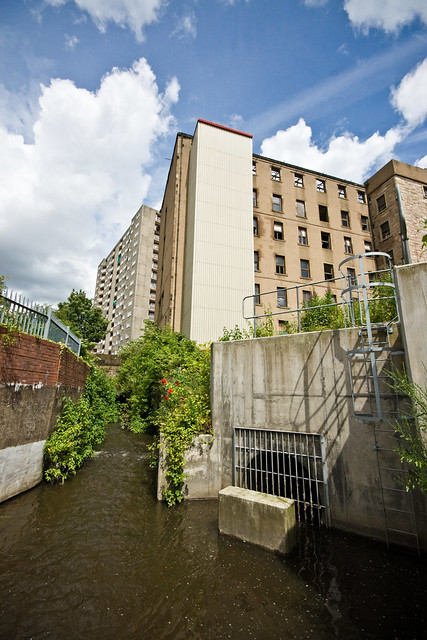
Hartwood Hospital

Hartwood Hospital was, at one time, the largest asylum in Europe, designed to house 500 patients in six wards.

Construction started in the beginning of 1890 on land purchased from Lord Deas (the “hanging judge”), with a branch line built from the nearby Hartwood Station. The official opening was on 20th May 1895, and by 1901 the hospital had over 800 patients, in a hospital that was it’s own self-contained world with it’s own farm, power plant, water supply, cottages for staff, bowling greens and train service. Hartwood pioneered the idea that psychiatric patients should not just be locked away, but some attempt should be made to treat them – Hartwood was the first hospital in Scotland to use Lobotomy as a cure, pioneered occupational therapy, and in 1985 was the first hospital to try community care.

The hospital just about made it to it’s centenary, and it’s College of Nursing, annexed to Strathclyde University’s Bell College, survived a bit longer and closed in 2000. Most of the wards were demolished, but the main building with it’s twin towers survived, and for a time became the Lanarkshire Media Centre, home to Lanarkshire TV, a short-lived local TV station. That lasted a couple of years then the building was abandoned, and suffered a serious fire in 2004. It now stands very derelict.

This was a two-day explore – first to have a look at the nursing college, then back a week later for the main building. The nursing college covers three sides of a square, and is an elegant Victorian stone building. Access isn’t for the faint-hearted…

Continue reading

William Paton Ltd.

William Paton Limited was founded at Johnstone in Scotland in 1840 by the twenty-one year old entrepreneur William Paton at the height of the Industrial Revolution. Paton began by meeting the local demand for hemp rope and moved on to the manufacture of cotton rope and a range of tapes. Before laces became the standard shoe fastener, Patons made elastic webbing for boots. Gradually the firm began to concentrate on the manufacture of boot laces before patenting a plaited fabric lace that would ultimately displace the traditional leather product.

The above was taken from http://www.punch.ie – The Punch group bought Paton’s in 1990. Paton’s mill incorporates part of the very first mill built in Johnstone in 1782, thought to be the first machine factory in the world, predating the New Lanark cotton mill by four years.

This A-listed building now stands empty and rotting after closing in 2003. There are suggestions that it might become a museum or flats.

Continue reading

The Molendinar Burn

The City of Glasgow’s name comes from the Gaelic Glasgu, meaning dear green place – the dear green place in question was a beautiful wooded valley beside the Molendinar Burn where St. Mungo (also known as Kentigern) founded a church in the 6th Century.

The Molendinar Burn kept it’s importance in Glasgow’s history for a long time – the later cathedral was built approximately on the site of St. Mungo’s church, and a bridge (the Bridge of Sighs) was built over the burn to the Necropolis. The burn also marked the eastern border of the city, and later was used to power the first of the mills that sprung up in the city.

The city outgrew the burn, though, and in the 1870s it was culverted over and almost forgotten – Wishart Street now runs along it’s path next to the cathedral. It’s exposed at one small section next to the old Great Eastern Hotel, so I went for a look.

The exposed section:

Molendinar Burn (by Ben Cooper)

Continue reading

Nestle Purina

The problem with GPS is that you need to put the right data in – I put in the address I found for this place, drove over there, and found lots of new flats. But I’d spotted an empty factory nearby which looked worth a go – it was only once I got inside that I realised that this was the place I was looking for…

The Nestle Purina factory in Barrhead, near Glasgow, made pet food – with a brief break to make baby food. The 200 employees were laid off in 2004, when Nestle decided that the factory was uneconomic.

First into the big storage warehouse:

Continue reading