Subway Depot

Glasgow’s Subway is the third-oldest subway system in the world, after London and Budapest, opened in 1896; two tracks run in a 6.5 mile loop with 15 stations north and south of the Clyde, and with a surface maintenance depot which the trains reach via a gradient.

The initial system was cable-driven – cables ran in a continuous loop driven by a surface steam engine, and the trains could clamp onto or release this cable. Later, the cars were converted to electric power – one of the old cars remains at the depot:

In 1977, the system was closed for a complete renovation – many stations were widened or even rebuilt entirely, the track was replaced, and entirely new rolling stock was ordered. Amusingly, because the old stations only had a centre platform, passengers only ever saw one side of the trains, so only one side was nicely painted!

Next to the old car is a cute little shunter:

The rest of this shed holds the modern rolling stock:

In a smaller shed, maintenance wagons are stored – these wagons are made from the chassis’ of the old pre-modernisation cars:

The largest shed holds the workshops:

A series of pits allow access under the trains:

There’s also a special tug which can drive on both rail and road:

Heather Mills

Did you know that Paul McCartney bought Heather Mills a plane for her birthday … and a Ladyshave for the other leg. Thank you very much, I’m here ’till Friday. So, anyway, Heather Mills in Selkirk in the Scottish Borders was founded in 1892 and soon became one of the town’s largest employers with over 200 workers. It was owned by Edinburgh Woollen Mills until March 2008, when it was bought by the Border Weaving Company, but orders dried up, and the company closed at the beginning of this year. One of the senior people told me “that’s how it goes – we’ve been closing mills here for 100 years”

Continue reading

Finnieston Crane

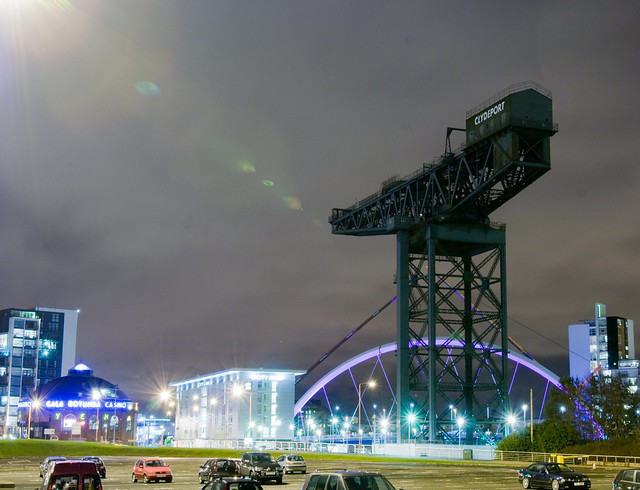
The Finnieston Crane is a Glasgow icon – the giant cantilever crane was used for fitting boilers into shops and loading large cargos, including locomotives. Now it stands disused in the middle of modern dockside redevelopment, appearing behind the presenter on the nightly news, but rarely visited.

Finnieston Crane (by Ben Cooper)

Continue reading

Longannet Colliery

Longannet Colliery employed 366 miners and 150 support staff near Kincardine, Fife, mining low-sulphur coal for the neighbouring Longannet Power Station; the power station uses up to 10,000 tonnes of coal per day.

Longannet was the last deep coal mine in Scotland, and because of it’s large reserves it had a bright future, until March 2002 when millions of gallons of water suddenly cascaded into the mine. Luckily no-one lost their lives, but the mine’s fate was sealed. Various campaigns have suggested reopening the mine, but the costs of pumping out the water and making the mine safe and profitable have been put at up to £100M, so instead the shaft was filled in and the surface buildings mostly demolished – by the time of my visit, only a couple of surface buildings remain, but they have quite a bit of interesting stuff.

A map of some of the workings:

Continue reading